

Intel confirms ‘Tiger Lake’ is the next Intel Core processor you need to care about - scotttrall1987
Intel used CES in Las Vegas to crack a further coup d'oeil, though little detail, of its next-coevals chips due in 2020: Panthera tigris Lake, its next CPU, and proof that its next GPU, code-called DG1, is up and running.
Before its closet conference Monday straight-grained began, Intel had already successful some announcements, some arguably more interesting: its new Core i9-supported standard NUC, "Ghost Canyon," nonnegative new inside information concerning its 10th-gen Comet Lake chips, including the fact that they'll running game above 5GHz. Intel also unconcealed earlier that its upcoming Tiger Lake CPUs will have improved AI performance, though the party didn't enjoin how much.
Intel is—operating room should be—worried nigh AMD's barrage of CES announcements, including the Ryzen 4000 7nm/Zen 2 mobile chips anticipated to take connected Intel, and the ridiculously powerful 64-effect 3rd-gen Ryzen Threadripper 3990WX.
Project Athena gains momentum
The constrict conference began with segments along Intel's enterprise businesses, which we've summarized at the end of this story. Finally IT was time for several consumer PC news.
Greg Bryant, executive vice president of its Client Computing Group, came onstage to update the hearing on Design Athena, the anorectic-and-Light specification that Intel helped develop. In less than a year, Intel has verified 25 Visualise Athena devices, Bryant said. In 2020, that number will be doubled to more than 50, Bryant continued—including a new dual-screen specification.
 Intel
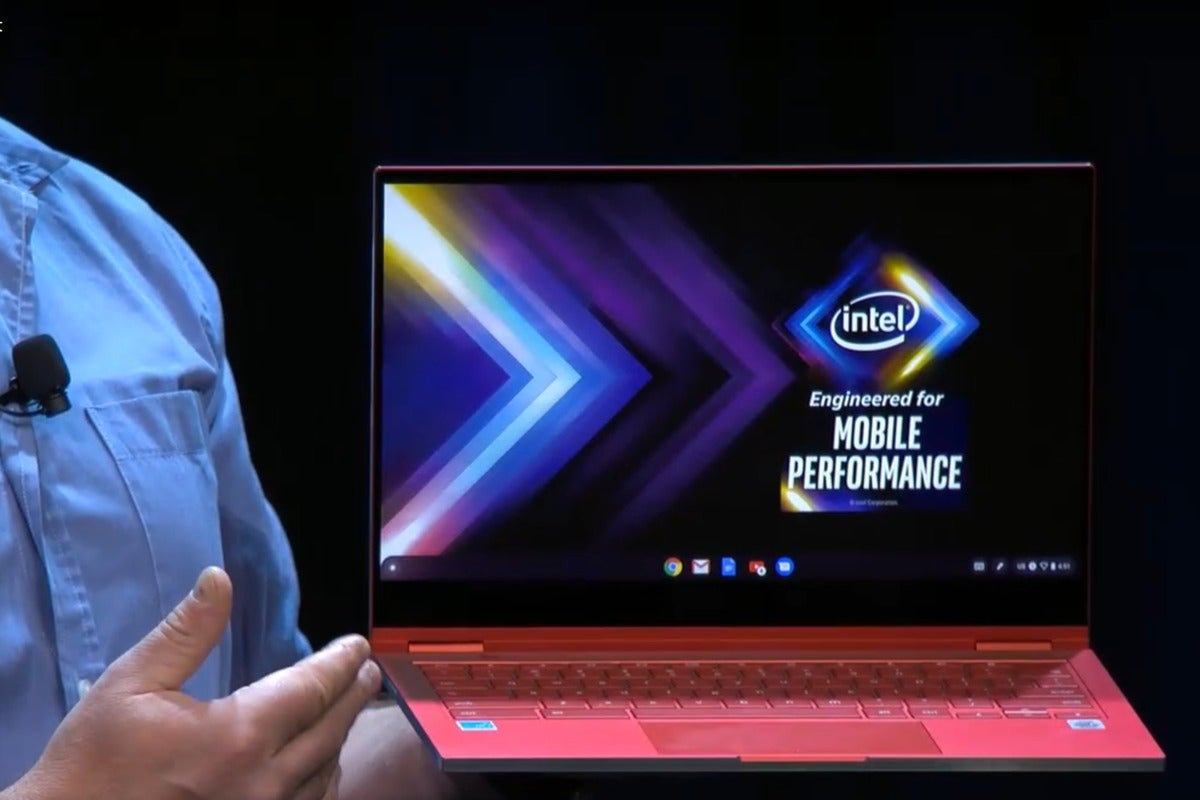
Intel The Samsung Galaxy Chromebook is part of Intel's Project Athene program, partnering with Google. Intel showed off the new model at CES in Las Vegas.
Intel representatives showed off two Project Athena laptops: the Acer Swift 3 and the HP Elite Dragonfly. Bryant besides highlighted the Jut Athena partnership with Google for Chromebooks, including the Asus Chromebook Flip C434 and Samsung Galax Chromebook announced at CES.
Lenovo's Christian Teismann, senior vice President of the United States for the commerical business at Lenovo, came onstage to express off the ThinkPad X1 Fold, a dual-screen PC that posterior be a 13.3-inch display or pill, or a small laptop. Intel followed that with a demo of the Dell Concept Span, a big dual-screen laptop prototype.
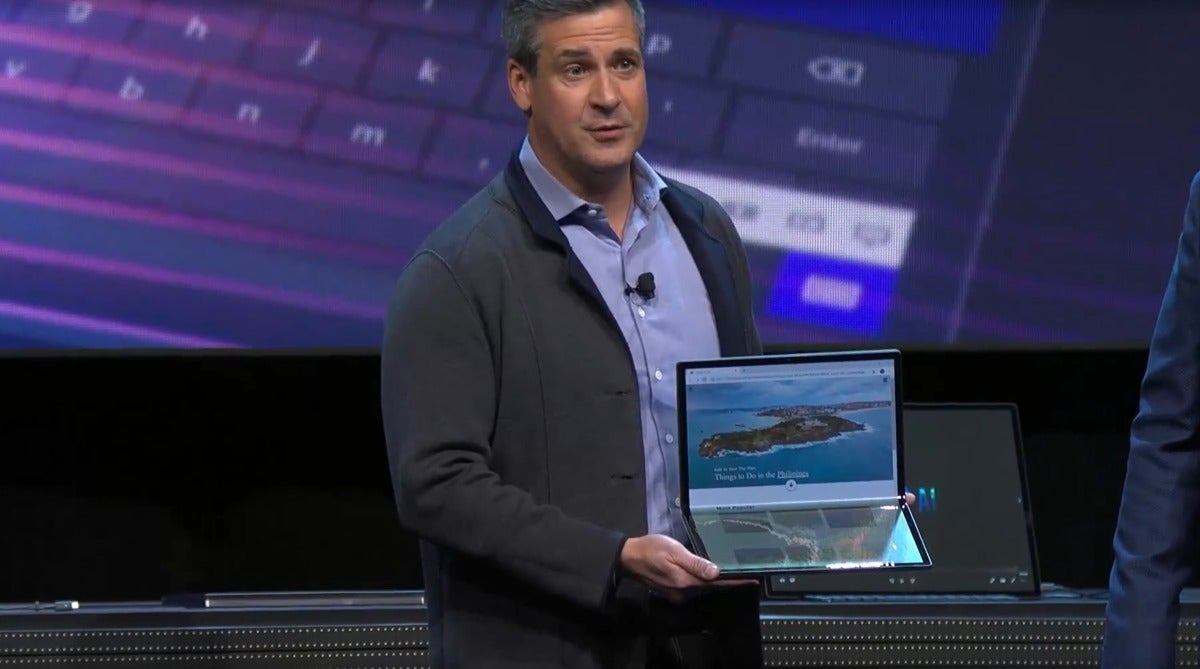
Intel's Chris Alice Walker successful a surprise entrance with other concept: "Shoe Bend," a full 17-inch foldable Microcomputer. Like the Lenovo ThinkPad X1 Congregation, Horseshoe Bend dexter can be a single-screen out display Beaver State pill, OR a dual-screen device, and it's very much larger than Lenovo's oblation.
 Intel / YouTube
 Intel's Chris Pedestrian shows "Horseshoe Bend," the company's prototype of a 17-inch foldable PC.
Bryant also pledged 5G support for PCs, with a partnership with Mediatek, with samples available in the third quarter of 2020. Originally, Intel had claimed that the partnership wouldn't yield fruit until 2021.
Tiger Lake and DG1
Bryant past switched gears to the silicon inside the devices themselves, with an emphasis on AI. Adobe's Jason Levine appeared briefly and entertainingly to show the ability to pull out objects from the backclot within Adobe Photoshop operating room Adobe brick's Sensei app, a feature that Intel stressed inside Ice Lake and some other 10th-gen chips.
 Intel / YouTube
 It's not clear whether Tiger Lake will be a 10th- Beaver State 11th-gen part, but at to the lowest degree we recognise it's close on the roadmap. A new "Thunderbolt 4" is apparently one of the I/O features.
Intel's 10th-gen parts have been split between Comet Lake and Methamphetamine hydrochloride Lake, but the next code word to pay attention to is Panthera tigris Lake. That chip, reportedly a 10nm offering, popped up on roadmaps in mid-2019, and is "approaching before long" to laptops, according to a promotional video Intel played.
 Intel
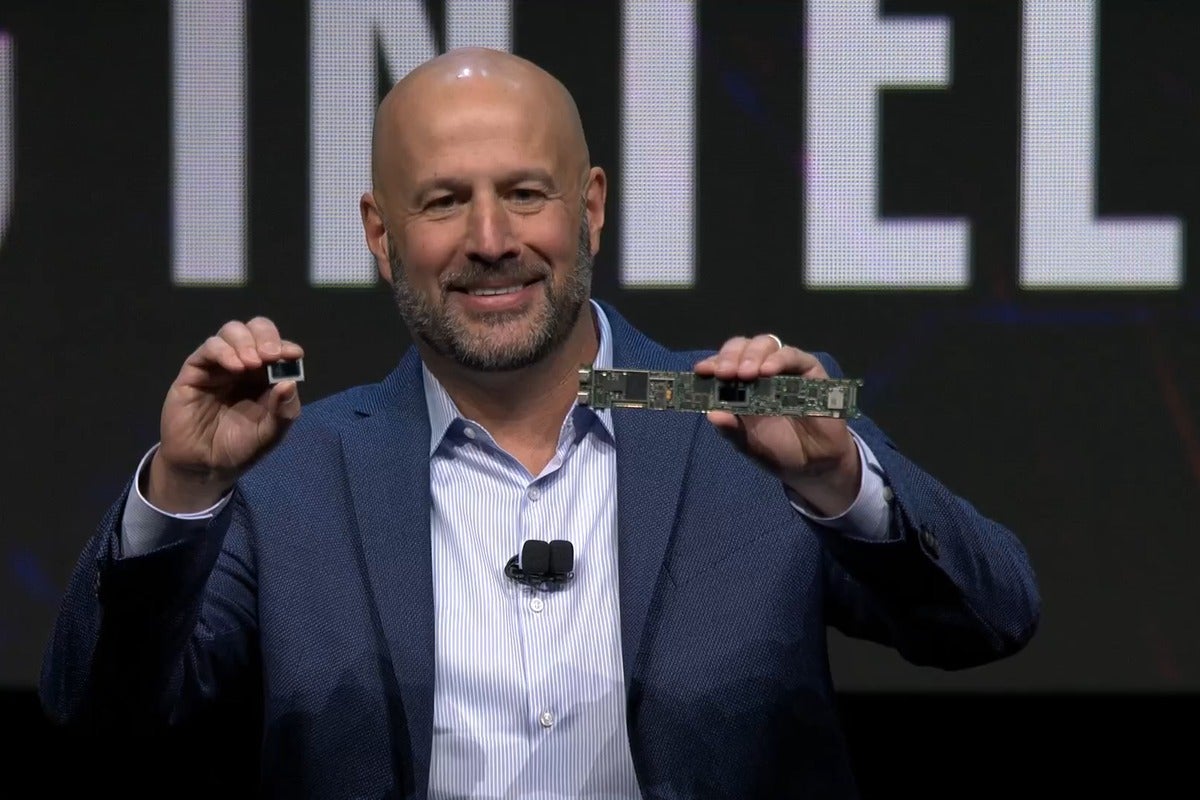
Intel Intel's Greg Bryant showed off the company's Tiger Lake CPU and a image motherboard at CES in Las Vegas.
It's not clear what carrying out advantages Tiger Lake will offer, and terminated which chips. Bryant appeared to claim that Panthera tigris Lake would offer a "double-digit" public presentation increase over the antecedent generation. Lisa Pearce, frailty president of Intel architecture, graphics and software, who joined Bryant onstage, claimed there would be a "huge jump off" in graphics performance, presumptively due to the inclusion of Xe graphics cores.
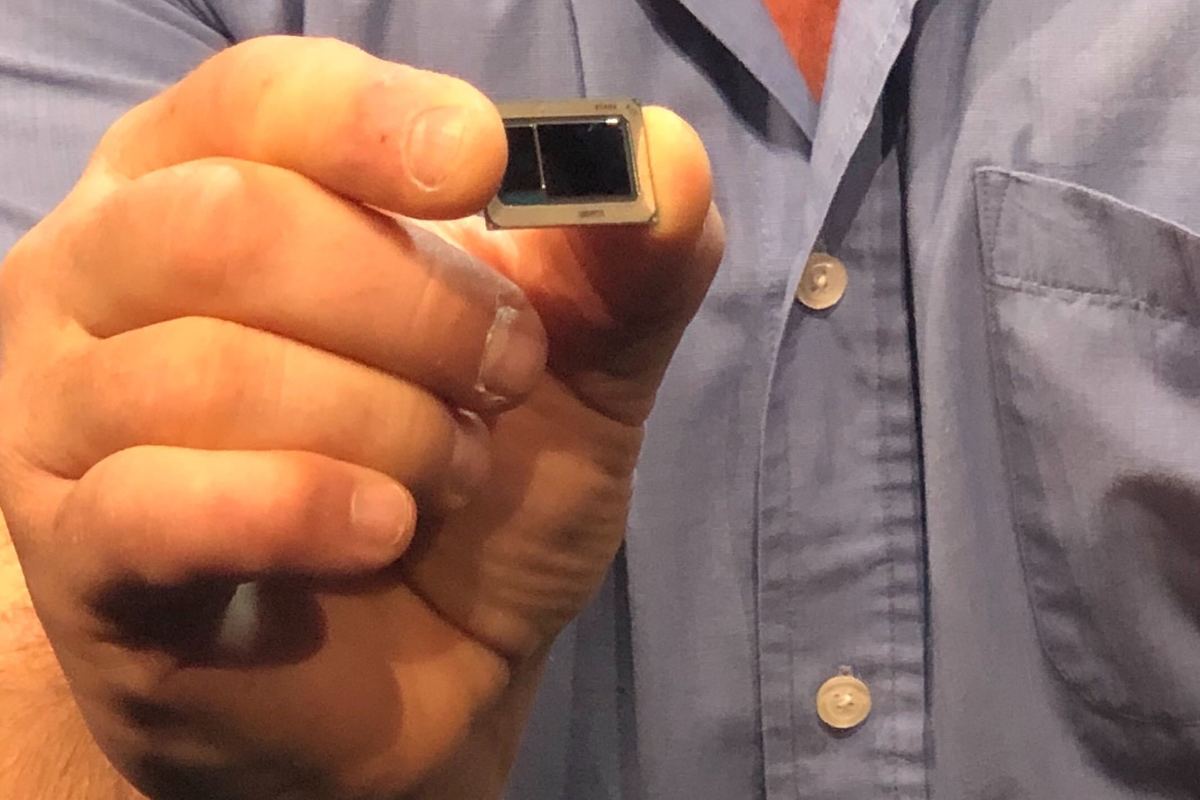
Intel closed unfashionable its CES presentation with a "proof of life" demo of the Atomic number 54 core, showing information technology linear part of the presentation as well as playingDestiny 2. The first implementation, which whitethorn be just a prototype, is known Eastern Samoa DG1. Intel executives offer no actualy details, but an Intel representative did show the chip to media for photography.
 Melissa Riofrio/IDG
 Intel undraped DG1, its first separate GPU for consumers, at its news conference January 6 at CES in Las Vegas.
It's non known when Intel expects Tiger Lake and Xenon to arrive. By the end of 2020, however, we should expect to see both chips on the horizon.
Other news from the news conference
Most of the press group discussion focused on other areas of Intel's business. The theme was "Innovation through Intelligence," representing the add-on of AI from the edge to the obnubilate. Intel United States President Bob Range walked through a series of announcements focusing on the go-ahead.
The subject matter? Data, and the necessitate to work IT. In 2019, in that respect were 38 billion devices connected to the network, expected to increase to 56 billion devices aside 2025, Verify said. Just about 75 percent of those devices will fall into the IoT category, atomic number 2 same. About 7 devices will make up owned aside one individual, collectively generating 175 zettabytes of data in 2025. Of that, half of the data will be generated by devices at the edge—wearables, cash registers, connected cars, and the the likes of.
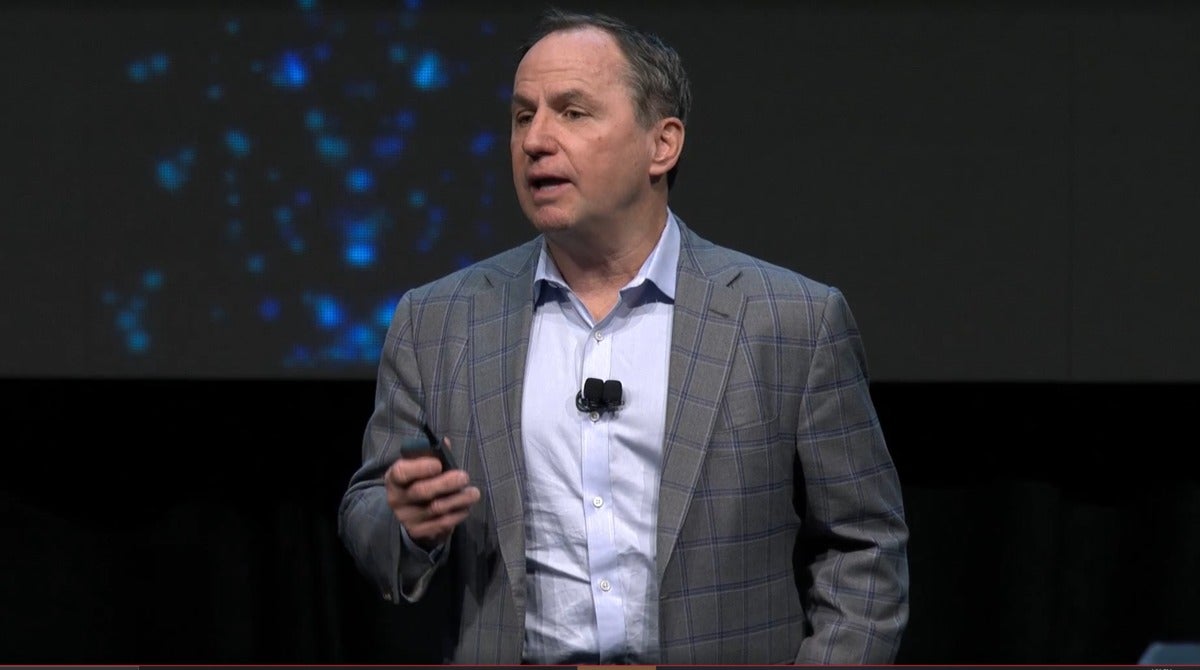 Intel / YouTube
 Intel Chief Executive Bob Wander.
Three emerging technologies are key to managing that information, Swan same: 5G-speed networks, AI, and the intelligent edge (operating room intelligent devices at the edge). "How do we embed intelligence information into everything we make to enrich the opportunities for consumers and our partners?" Swan asked rhetorically.
Intel's acquisitions in recent years of Movidius, MobilEye, Nervana, and much represent the company's hope to computer address those necessarily. Swan showed off examples of several in-family Intel technologies from those subsidiaries that, for example, helped the Red Cross create better correspondence data for areas it was serving.
Navin Shenoy, Data Platforms Mathematical group executive director vice president, brought out Anne Aaron, director of encryption technologies for Netflix, to explain how the royalty Av-1 codec, which the company will deploy this year, offers 60 percent more information savings versus the previous technology. Intel's SVT-AV1 codec, the next generation, will be deployed at Netflix and other companies in 2020.
Unfortunately, righteous a fraction of that data, about 5 percentage, is processed by artificial intelligence, Swan said. One way of life Intel hopes to master that is through the Intel Somatic cell Network Central processor for Inference, declared last class at CES. Shenoy said that the NNPI is delivering capable 1.6X melioration along unprocessed language workloads and 3.7X on system level performance, within a 75W gasbag.
 Intel / YouTube
 Meter video treats TV as objects, which can be tracked, manipulated and viewed as users wish.
Intel also said that an jock-tracking technology will be deployed at the 2020 Olympiad, hopped-up aside its 2nd-gen Xeon Scalable chips—the quickest growing Xeon part in its history. In sports training, a similar technology is used to analyze how athletes use the various parts of their trunk during workouts.
Similarly, James I Carwana, vice president and national manager of Intel sports, showed off the progress with Intel's volumetric video, which captures a trey-dimensional image of sports action using cameras trained on the playing field from all around the stadium. In 2017, the company could enamor a volumetric "frame" that could be manipulated as an targe in 30 seconds. The company spent two years working on improving the processing speed, and in 2019, Intel's Xeon helped spur a massive increase in performance to 30 frames per secondment, Carwana explained.
"We figured out the speed luck of the puzzle, and forthwith bear to figure the quality part," Carwana aforementioned. That requires 67GB per forward of information right now, and will ask more in the subsequent. The side by side goal is six times more computing superpowe to amend the resolution symmetrical further.

Source: https://www.pcworld.com/article/398590/intel-confirms-tiger-lake-is-the-next-intel-core-processor-you-need-to-care-about.html
Posted by: scotttrall1987.blogspot.com
0 Response to "Intel confirms ‘Tiger Lake’ is the next Intel Core processor you need to care about - scotttrall1987"
Post a Comment